🎗️Lonny's War Update- October 708, 2023 - September 13, 2025 🎗️
🎗️Day 708 that 48 of our hostages are still in Hamas captivity🎗️
**There is nothing more important than getting them home! NOTHING!**
“I’ve never met them,But I miss them. I’ve never met them,but I think of them every second. I’ve never met them,but they are my family. BRING THEM HOME NOW!!!”
Red Alerts - Missile, Rocket, Drone (UAV - unmanned aerial vehicles), and Terror Attacks and Death Announcements
*3:45am - Central Israel and Tel Aviv areas - ballistic missile from Yemen - successfully intercepted - no reports of injuries or damages
Hostage Updates

Mossad chief David Barnea opposed implementing the plan, fearing it would rupture his agency’s relationship with Qatar, which has been mediating hostage talks between Israel and Hamas.
The Post says that the Mossad’s pushback led Prime Minister Benjamin Netanyahu to go with an airstrike on Hamas’s compound in Doha, deploying 15 fighter jets that launched 10 missiles from afar — apparently with limited success.
Israel’s security establishment backs the need for eliminating all of Hamas’s leaders, but pushed back on the timing and location of this week’s operation before being overruled by Netanyahu.
“We can get them in one, two, or four years from now, and the Mossad knows how to do it,” one of the Israeli sources told The Post, referencing the possibility of covertly assassinating Hamas leaders anywhere in the world at a later date. “Why do it now?”
Joining Barnea in opposing this week’s strike was IDF Chief of Staff Lt. Gen. Eyal Zamir, while Strategic Affairs Minister Ron Dermer and Defense Minister Israel Katz backed the operation.
Nitzan Alon, the IDF’s point man for hostage talks, was not invited to the ministerial consult ahead of the strike. link The Mossad was absolutely right in refusing to participate in this plan which would surely kill negotiations for the Trump plan or any other plan put forth. No one disagrees that all if the Hamas leadership is destined to short lives but that could happen later, as they have been saying about the entire war as well. When the negotiating team was led by the Chiefs of the Shin Bet and Mossad, the prime and most important goal was to bring home all of the hostages, even if it meant to end the war. They spoke openly to Netanyahu that they, the security organizations could deal with everything after the hostages are home, including elimination of the Hamas leadership. We should all remember that all those involved in the Munich massacre and the kidnapping and holding of Gilad Schalit are no longer breathing. It may take years but they are all targets and should be considered dead men walking. However, that didn’t suit Netanyahu because he did not and does not want to end the war. Continuing the war suits his goals for political survival. It is exactly fir that purpose that he removed the Shin Bet and Mossad chiefs from the negotiating team. He wanted his yes man Dermer to prevent any deal or discussion that includes ending the war. In the over 7 months that Dermer has led the negotiating team, not a single hostage has come home due to his actions as he continually refuses to meet with any of the hostage families.
Mossad chief David Barnea opposed implementing the plan, fearing it would rupture his agency’s relationship with Qatar, which has been mediating hostage talks between Israel and Hamas.
The Post says that the Mossad’s pushback led Prime Minister Benjamin Netanyahu to go with an airstrike on Hamas’s compound in Doha, deploying 15 fighter jets that launched 10 missiles from afar — apparently with limited success.
Israel’s security establishment backs the need for eliminating all of Hamas’s leaders, but pushed back on the timing and location of this week’s operation before being overruled by Netanyahu.
“We can get them in one, two, or four years from now, and the Mossad knows how to do it,” one of the Israeli sources told The Post, referencing the possibility of covertly assassinating Hamas leaders anywhere in the world at a later date. “Why do it now?”
Joining Barnea in opposing this week’s strike was IDF Chief of Staff Lt. Gen. Eyal Zamir, while Strategic Affairs Minister Ron Dermer and Defense Minister Israel Katz backed the operation.
Nitzan Alon, the IDF’s point man for hostage talks, was not invited to the ministerial consult ahead of the strike. link The Mossad was absolutely right in refusing to participate in this plan which would surely kill negotiations for the Trump plan or any other plan put forth. No one disagrees that all if the Hamas leadership is destined to short lives but that could happen later, as they have been saying about the entire war as well. When the negotiating team was led by the Chiefs of the Shin Bet and Mossad, the prime and most important goal was to bring home all of the hostages, even if it meant to end the war. They spoke openly to Netanyahu that they, the security organizations could deal with everything after the hostages are home, including elimination of the Hamas leadership. We should all remember that all those involved in the Munich massacre and the kidnapping and holding of Gilad Schalit are no longer breathing. It may take years but they are all targets and should be considered dead men walking. However, that didn’t suit Netanyahu because he did not and does not want to end the war. Continuing the war suits his goals for political survival. It is exactly fir that purpose that he removed the Shin Bet and Mossad chiefs from the negotiating team. He wanted his yes man Dermer to prevent any deal or discussion that includes ending the war. In the over 7 months that Dermer has led the negotiating team, not a single hostage has come home due to his actions as he continually refuses to meet with any of the hostage families.
 Thousands attend a protest march in Jerusalem, calling for a deal to end to the war and secure the release of all the hostages from Hamas captivity, September 6, 2025. (Yonatan Sindel/FLASH90)
The heads of Israeli security agencies warned ministers during a meeting earlier today convened by Prime Minister Benjamin Netanyahu that the planned Gaza City takeover will “inevitably” lead to the killing of hostages, the Kan public broadcaster reports.
The prediction is more definitive than previous ones given by the security establishment about the Gaza City operation. In the past, the cabinet has warned that the operation could likely place the hostages being held there at risk.
The security chiefs also warned ministers in today’s meeting that while the evacuation of Gaza City has gone relatively well thus far, hundreds of thousands of the one million people who were living in the area are likely to remain, as opposed to last year’s Rafah operation, where the IDF managed to clear out almost everyone ahead of time.
Many Palestinians have been refusing to leave Gaza City, believing that they’d rather be killed in their homes, as opposed to an uncertain evacuation process to heavily crowded tent-cities in the south, where resources will be even more limited as the displaced population balloons. Hamas is also said to be discouraging Palestinians from heeding evacuation orders, as Israel says it is expanding humanitarian services for the displaced population.
The security chiefs told cabinet members the large population expected to remain in Gaza City will become the responsibility of the IDF and troops will have to provide them with aid and other basic services, Kan reports.
Moreover, the security establishment warned that the Gaza City takeover will take much longer than currently anticipated. While Netanyahu says he has ordered the IDF to shrink the timeline for the operation, the security chiefs said it will likely take many months, and even then, it’s unclear whether the goals of the takeover will be met, Kan reports.
- Trump and Qatar's Prime Minister met; report: discussed its future as mediator and security cooperation
U.S. President Donald Trump and his Middle East envoy Steve Whitkoff met with Qatar's Prime Minister Mohammed al-Thani in New York against the backdrop of Israel's strike in Doha. This was reported by Reuters news agency, which noted that the White House confirmed the meeting took place but provided no further details. According to the report, Trump said during the conversation that he is not satisfied with Israel's strikes in the region and described them as not advancing the interests of Washington and Jerusalem. It was also reported that prior to this, Thani spoke with Vice President J.D. Vance and Secretary of State Marco Rubio. A source familiar with the meeting details said that Vance, Rubio and Thani discussed Qatar's future as a mediator in the region, as well as "security cooperation in light of the strike in Doha."
Gaza and the South
The heads of Israeli security agencies warned ministers during a meeting earlier today convened by Prime Minister Benjamin Netanyahu that the planned Gaza City takeover will “inevitably” lead to the killing of hostages, the Kan public broadcaster reports.
The prediction is more definitive than previous ones given by the security establishment about the Gaza City operation. In the past, the cabinet has warned that the operation could likely place the hostages being held there at risk.
The security chiefs also warned ministers in today’s meeting that while the evacuation of Gaza City has gone relatively well thus far, hundreds of thousands of the one million people who were living in the area are likely to remain, as opposed to last year’s Rafah operation, where the IDF managed to clear out almost everyone ahead of time.
Many Palestinians have been refusing to leave Gaza City, believing that they’d rather be killed in their homes, as opposed to an uncertain evacuation process to heavily crowded tent-cities in the south, where resources will be even more limited as the displaced population balloons. Hamas is also said to be discouraging Palestinians from heeding evacuation orders, as Israel says it is expanding humanitarian services for the displaced population.
The security chiefs told cabinet members the large population expected to remain in Gaza City will become the responsibility of the IDF and troops will have to provide them with aid and other basic services, Kan reports.
Moreover, the security establishment warned that the Gaza City takeover will take much longer than currently anticipated. While Netanyahu says he has ordered the IDF to shrink the timeline for the operation, the security chiefs said it will likely take many months, and even then, it’s unclear whether the goals of the takeover will be met, Kan reports.
U.S. President Donald Trump and his Middle East envoy Steve Whitkoff met with Qatar's Prime Minister Mohammed al-Thani in New York against the backdrop of Israel's strike in Doha. This was reported by Reuters news agency, which noted that the White House confirmed the meeting took place but provided no further details. According to the report, Trump said during the conversation that he is not satisfied with Israel's strikes in the region and described them as not advancing the interests of Washington and Jerusalem. It was also reported that prior to this, Thani spoke with Vice President J.D. Vance and Secretary of State Marco Rubio. A source familiar with the meeting details said that Vance, Rubio and Thani discussed Qatar's future as a mediator in the region, as well as "security cooperation in light of the strike in Doha."
- 50 reported killed throughout Strip Friday as Israel steps up attacks on Gaza City
Israeli military operations killed 50 people in Gaza on Friday, the territory’s Hamas-run civil defense agency says, as the army stepped up its attacks on Gaza City.
The civil defense agency says 35 people were killed in the city on Friday, along with another 15 in other parts of the territory.
The Israeli military says it is continuing “its wide-scale strikes on terrorist infrastructure and high-rise structures” in Gaza City.

This picture shows an Israeli projectile targeting a building on Jalaa Street in Gaza City on September 12, 2025. (Omar AL-QATTAA / AFP)
Media restrictions in Gaza and difficulties in accessing many areas mean international news agencies are unable to independently verify the details provided by the civil defense agency or the Israeli military.
A single strike in the northwest of Gaza City killed 14 people, the civil defense said.
“The majority of them are children and women,” relative Hazem al Sultan tells AFP. “Only two bodies were intact, while the rest were body parts.”

Children sit atop piled up mattresses as Palestinians flee south from Gaza City with their belongings, via the coastal road near the Nuseirat refugee camp in the central Gaza Strip, on September 12, 2025. (Eyad BABA / AFP)
At the city’s Al-Shifa hospital, mourners pray over the dead wrapped in white shrouds, some of them the size of children.
The military did not respond to a request for comment on the strike.
While the army has issued multiple evacuation warnings for Gaza City, many residents have told AFP they have nowhere else to go, noting Israel has repeatedly struck the area in the south to which it has urged people to move. 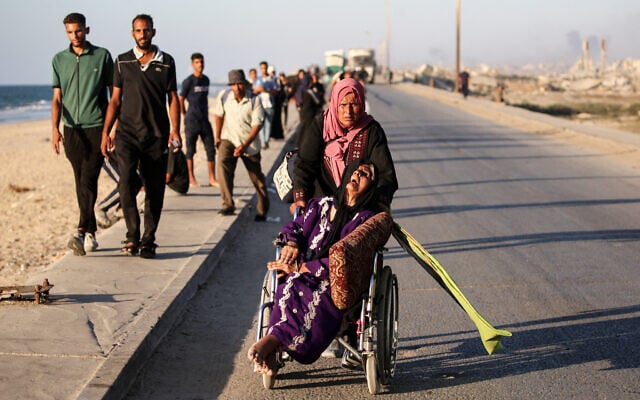 A woman pushes the wheelchair of an elderly person as Palestinians flee south from Gaza City via the coastal road near the Nuseirat refugee camp in the central Gaza Strip, on September 12, 2025. (Eyad BABA / AFP)
10,000 children in Gaza City diagnosed with acute malnutrition in past two months — UNICEF

Palestinians shove to receive a hot meal from a charity kitchen in the Nuseirat refugee camp in the Gaza Strip, on September 4, 2025. (Eyad BABA / AFP)
The United Nations Children’s Fund reports that over 10,000 children in Gaza City have been diagnosed with acute malnutrition in the past two months alone.
The agency warns that if disconnected from their treatment, there is a high risk that some of the 2,400 children currently being treated for severe acute malnutrition in the area could starve to death.
Meanwhile, 11,000 people evacuated Gaza City southward between 2 p.m. Wednesday and 2 p.m. Thursday, UN spokesperson Stéphane Dujarric says during a briefing.
Yesterday, a UN team successfully delivered fuel to a series of critical service providers in Gaza City — a rarity during the war, as Israel limits the entry of fuel due to concerns that it is used by Hamas fighters.
The fuel is used to operate hospitals and other health facilities, and for water treatment, trucking, desalination and waste management. link

Israeli military operations killed 50 people in Gaza on Friday, the territory’s Hamas-run civil defense agency says, as the army stepped up its attacks on Gaza City.
The civil defense agency says 35 people were killed in the city on Friday, along with another 15 in other parts of the territory.
The Israeli military says it is continuing “its wide-scale strikes on terrorist infrastructure and high-rise structures” in Gaza City.
This picture shows an Israeli projectile targeting a building on Jalaa Street in Gaza City on September 12, 2025. (Omar AL-QATTAA / AFP)
Media restrictions in Gaza and difficulties in accessing many areas mean international news agencies are unable to independently verify the details provided by the civil defense agency or the Israeli military.
A single strike in the northwest of Gaza City killed 14 people, the civil defense said.
“The majority of them are children and women,” relative Hazem al Sultan tells AFP. “Only two bodies were intact, while the rest were body parts.”
Children sit atop piled up mattresses as Palestinians flee south from Gaza City with their belongings, via the coastal road near the Nuseirat refugee camp in the central Gaza Strip, on September 12, 2025. (Eyad BABA / AFP)
At the city’s Al-Shifa hospital, mourners pray over the dead wrapped in white shrouds, some of them the size of children.
The military did not respond to a request for comment on the strike.
While the army has issued multiple evacuation warnings for Gaza City, many residents have told AFP they have nowhere else to go, noting Israel has repeatedly struck the area in the south to which it has urged people to move. A woman pushes the wheelchair of an elderly person as Palestinians flee south from Gaza City via the coastal road near the Nuseirat refugee camp in the central Gaza Strip, on September 12, 2025. (Eyad BABA / AFP)
10,000 children in Gaza City diagnosed with acute malnutrition in past two months — UNICEF
Palestinians shove to receive a hot meal from a charity kitchen in the Nuseirat refugee camp in the Gaza Strip, on September 4, 2025. (Eyad BABA / AFP)
The United Nations Children’s Fund reports that over 10,000 children in Gaza City have been diagnosed with acute malnutrition in the past two months alone.
The agency warns that if disconnected from their treatment, there is a high risk that some of the 2,400 children currently being treated for severe acute malnutrition in the area could starve to death.
Meanwhile, 11,000 people evacuated Gaza City southward between 2 p.m. Wednesday and 2 p.m. Thursday, UN spokesperson Stéphane Dujarric says during a briefing.
Yesterday, a UN team successfully delivered fuel to a series of critical service providers in Gaza City — a rarity during the war, as Israel limits the entry of fuel due to concerns that it is used by Hamas fighters.
The fuel is used to operate hospitals and other health facilities, and for water treatment, trucking, desalination and waste management. link
IDF says it struck 500 targets in Gaza City this week in preparation for takeover
The Israeli Air Force struck over 500 targets in Gaza City this week in five main waves, as part of preparations for an upcoming major ground offensive against Hamas in the area, the military says.
The first three waves focused on Gaza City’s Daraj, Tuffah and Sheikh Radwan neighborhoods. In recent days, the IDF says it expanded its strikes to the Shati camp and additional areas in Sheikh Radwan.
The strikes have destroyed several high-rise towers that the IDF says were being used by Hamas for surveillance, as sniper posts, to store weapons, and some of which had tunnels running underneath them.
Ahead of the strikes, the IDF issued warnings to Palestinian civilians residing in the area.
IDF says it struck 500 targets in Gaza City this week in preparation for takeover
The Israeli Air Force struck over 500 targets in Gaza City this week in five main waves, as part of preparations for an upcoming major ground offensive against Hamas in the area, the military says.
The first three waves focused on Gaza City’s Daraj, Tuffah and Sheikh Radwan neighborhoods. In recent days, the IDF says it expanded its strikes to the Shati camp and additional areas in Sheikh Radwan.
The strikes have destroyed several high-rise towers that the IDF says were being used by Hamas for surveillance, as sniper posts, to store weapons, and some of which had tunnels running underneath them.
Ahead of the strikes, the IDF issued warnings to Palestinian civilians residing in the area.
Northern Israel, Lebanon and Syria
- Sharaa says Syria in talks with Israel on security deal
Syrian President Ahmed al-Sharaa says his country is negotiating with Israel to reach a security agreement that would see Israel leave areas it occupied after the December overthrow of Bashar al-Assad.
As Islamist-led forces toppled Assad on December 8, Israel deployed troops to the UN-patrolled buffer zone on the Golan Heights, which has separated Israeli and Syrian forces since an armistice that followed the 1973 Arab-Israeli war.
Israel has also launched hundreds of airstrikes on targets in Syria and carried out incursions deeper into the south. Syria’s new authorities have not responded to the attacks.
“We are now in a state of negotiations and dialogue on the issue of a security agreement,” Sharaa says in an interview with state television channel Alekhbariah.
He says that Israel believed that Syria had “quit” the 1974 disengagement agreement after Assad’s fall, “even though Syria, from the first moment, expressed its commitment” to the accord.
“Now, negotiations are underway on a security agreement to return Israel to where it was before December 8,” Sharaa says.
Israel and Syria have no diplomatic relations, with the two countries technically at war since 1948.
In the interview, Sharaa reveals that Syrian forces entered secret negotiations with key Assad ally Russia during the offensive that eventually toppled the longtime ruler.
“When we reached Hama in the battle of liberation, there were negotiations between us and Russia,” Sharaa says.
When forces arrived in Homs further south, Russia “stayed away from the battle… as part of an agreement reached between us,” he says.
West Bank, Jerusalem, Israel and Terror Attacks
Politics and the War and General News
Israel said checking to see if Hamas leadership was even in building it struck in Doha
As the Israeli security establishment increasingly believes that none of Hamas’s leadership was killed in the Tuesday IDF strike in Doha, it has begun checking whether the terror group’s top brass was even in the building that was targeted, Channel 12 reports.
The other possibility still being examined is that the Hamas leaders were in a different part of the building than the section that was hit directly.
The security establishment believes that one or two Hamas leaders may have been injured — potentially Khalil al-Hayya among them. This could explain Hamas’s decision not to release a photo of him in its statement earlier today announcing that he is still alive.
Another scenario being checked is whether the Hamas leaders managed to get a heads-up at the last minute, which enabled them to escape ahead of time, though that would mean that top officials like Hayya didn’t alert his son Hammam, who was killed in the strike.
Further boosting Israeli understanding that Doha strike failed, Hamas says Hayya attended funeral for ‘martyred’ son

Hamas issues a statement announcing that its Qatar-based Gaza head of the terror group Khalil al-Hayya attended yesterday’s funeral for his “martyred” son Hammam, who was killed along with four other Hamas members and a Qatari security guard in the “treacherous” Tuesday Israeli strike targeting Hamas leaders in Doha.The funeral was able to take place thanks to “special security arrangements” in Qatar, the Hamas statement adds.
The statement is an effective negation of initial rumors that the elder Hayya was killed in the Israeli strike, though Hamas doesn’t publish a corroborating photo.
Israel’s security establishment has begun to privately acknowledge that the strike was not successful in eliminating any of Hamas’s top leaders.
Still, none of the top brass has been spotted publicly since the strike, as Hamas and Qatar have tried to maintain an information vacuum since.
Hayya has been heading Hamas’s hostage negotiating team.
The failure of the strike in Qatar is deeper than it seems
The assassination attempt daring in Doha might turn out to be a strategic mistake whose price is higher than the benefit • Even if the action did not fail operationally completely, it caused enormous diplomatic damage: it harmed the trust with Qatar and the Arab world, complicated the relations with the United States, strengthened our enemies and did not advance the release of the hostages • In the test of the result, Israel remained more isolated • Commentary
The assassination attempt of the leaders of the political bureau of Hamas in Doha by Israel was surprising and daring. From an operational point of view the action apparently failed, but even if it had succeeded, in the test of cost versus benefit it seems that the negative outweighs the positive. This is not only hindsight wisdom; most of the results of the action could have been foreseen in advance:
Israel is a state that one cannot give trust in
Over the years were built between Israel and several of the Gulf states – including Qatar – relations of trust in behind-the-scenes contacts. Key figures from the Mossad and the Ministry of Foreign Affairs, including heads of Mossad and directors general of the ministry, nurtured these ties with great effort. It was not surprising therefore that the head of Mossad opposed the assassination action, at least at the current timing. Beyond the fact that the thing will harm the Israel-Qatar relations (see below), harming a mediator that enjoys immunity by virtue of his role constitutes an exceptional act in diplomacy.
Moreover, Israel already has a history of breaches of trust, when it tried to assassinate, without success, Khaled Mashal on Jordanian soil in 1997; when it assassinated Mahmoud al-Mabhouh in the United Arab Emirates in 2010; and when, differently, Netanyahu leaked the matter of his meeting with the Saudi crown prince, Bin Salman, in the city Neom in 2020.
In contrast to strikes that were carried out in Iran, Syria or Lebanon - enemy states for all intents and purposes - these states established peace (Jordan) or secret relations (Emirates and Saudi Arabia) with Israel. Therefore, these actions aroused feelings of betrayal of trust on the Arab side, and the result – the relations were harmed for a significant period.
Growing concern from Israeli hegemony
The states of the Middle East - including the states of peace and normalization - fear that Israel will acquire a hegemonic status in the regional system. When Shimon Peres came out with the idea of "the new Middle East" after the Oslo accords, he encountered Arab opposition out of fear of Israeli economic hegemony. Following its military successes, and because of inflammatory statements by ministers in the government, the mystical belief that Israel is striving for the establishment of "Greater Israel" from the Euphrates to the Nile receives reinforcement, a thing that might lead players in the region to look for alternatives.
Non-advancement of issues of ending the war and release of the hostages
From the start, it is not clear how the strike was supposed to help in ending the war and releasing the hostages. For thought - if there was such - that the assassination of Hamas leaders will lead to softening the position of the organization, it seems that it had nothing to rely on. It is not far-fetched to suppose equally, that the action actually would have strengthened the determination of Hamas in Gaza to fight until the end. Moreover, if the action had succeeded, it might have led to the execution of hostages; and if the war will continue until the bitter end, it can end in the death of the hostages also.
On the other hand, the action taught Hamas - and maybe other enemies - that they are not immune in any city of refuge.
Pushing the United States into straits
As known, both Qatar and Israel are allies of the United States. The alliance of the one does not come at the expense of the other. However, the strike put Trump in an embarrassing situation, that he supposedly was forced "to choose" between the attacker and the attacked and he "chose" Israel because he knew in advance about the strike. Not surprising that his reaction to the strike was reserved, stammering ("I am not pleased") and tending to hold the stick from both sides. To remove doubts, he hurried to declare about holding a meeting with the Prime Minister of Qatar and repeated that she is a strong ally of the United States.
Strengthening the Arab solidarity – at least in the short term
If until today it was customary to make a pilgrimage to the holy places of Islam in Mecca and Medina in Saudi Arabia, now leaders and ministers make a pilgrimage to Doha in order to express their solidarity with Qatar. Moreover, Qatar called for an emergency summit of Arab and Islamic states to discuss the strike and to adopt a common position. From this perspective, the strike added to this tiny kingdom - that was at all isolated and boycotted between the years 2017-2021 - prestige and influence.
Some of the pilgrims are at all in rivalry and competition with Qatar, but the violation of its sovereignty by Israel is an act that might threaten also them, at such or another time. A similar resolute response, differently, was when the ruler of Iraq Saddam Hussein invaded Kuwait in 1990. His takeover of Kuwait might have served as a precedent for takeover of other states and that needed to be cut at its bud.
Damage to Israel-Qatar relations
It is difficult to measure at this stage the extent of the damage that was caused to Israel-Qatar relations, but examples of the past teach that breaches of trust were punished by temporary suspension of the ties. There are those who will argue that in any case the Qatari mediation or the connection with it harm Israel - especially following the double game that it plays between the sides, the hostile broadcasts of Al-Jazeera and the transfer of money to "charity" organizations and university institutions in the West with the aim of increasing extremist Islamic propaganda.
Qatar maintains ties with Israel since the two established diplomatic relations in 1996. The official relations indeed were severed following Operation "Cast Lead" in 2009, but behind the scenes they continued, especially since Qatar began transferring money to Gaza and to Hamas with Israel’s agreement. While Netanyahu and others on the right saw in Hamas an asset in preserving the division in the Palestinian arena, the Mossad and the security elements saw in Qatar an essential mediator – even if not always fair – between Israel and Hamas, especially following the deadlock in the Palestinian arena.
While Netanyahu supported from the start the Qatari involvement, it is not impossible that the accusations against him in the "Qatargate" affair also pushed him to the action as part of the attempt to remove this burden from his back.
At this stage it seems that Qatar does not intend to grant Israel the gift of cessation of mediation. It is clear that it is not hurrying to part from the role that granted it access to all the rival sides, and especially to the United States, and raised its prestige around the world. In the test of the result, it seems therefore that the disadvantages of the action outweigh its advantages.
It could be that the hubris of military successes in the other arenas contributed also its action. Qatar will continue to be a "complicated" state, because it is not eager to be an enemy of anyone as a declared policy. Putting it in one camp with Iran, Hezbollah, the Houthis and Hamas – and as a result of this, declaring it as an enemy – not only does not serve Israel and is not supported by the United States, but it, in my estimation, is not correct. The system of relations between Israel and Qatar fits the model of what they call in international relations "enemy-friend" (in English it sounds better: frenemies), including components of hostility and friendship – a result of changing interests. Trump’s good connection also with Israel and also with Qatar and the need for mediation for the cessation of the war and for the release of the hostages might perhaps shorten the period of "the sulk" between the two states, but feelings of humiliation, insult and mistrust on the Qatari side will continue to cloud the ties.
>>> Prof. Eli Podeh teaches in the Department of Islamic and Middle Eastern Studies at the Hebrew University and member of the managing board of Mitvim. link
Syrian President Ahmed al-Sharaa says his country is negotiating with Israel to reach a security agreement that would see Israel leave areas it occupied after the December overthrow of Bashar al-Assad.
As Islamist-led forces toppled Assad on December 8, Israel deployed troops to the UN-patrolled buffer zone on the Golan Heights, which has separated Israeli and Syrian forces since an armistice that followed the 1973 Arab-Israeli war.
Israel has also launched hundreds of airstrikes on targets in Syria and carried out incursions deeper into the south. Syria’s new authorities have not responded to the attacks.
“We are now in a state of negotiations and dialogue on the issue of a security agreement,” Sharaa says in an interview with state television channel Alekhbariah.
He says that Israel believed that Syria had “quit” the 1974 disengagement agreement after Assad’s fall, “even though Syria, from the first moment, expressed its commitment” to the accord.
“Now, negotiations are underway on a security agreement to return Israel to where it was before December 8,” Sharaa says.
Israel and Syria have no diplomatic relations, with the two countries technically at war since 1948.
In the interview, Sharaa reveals that Syrian forces entered secret negotiations with key Assad ally Russia during the offensive that eventually toppled the longtime ruler.
“When we reached Hama in the battle of liberation, there were negotiations between us and Russia,” Sharaa says.
When forces arrived in Homs further south, Russia “stayed away from the battle… as part of an agreement reached between us,” he says.
Israel said checking to see if Hamas leadership was even in building it struck in Doha
As the Israeli security establishment increasingly believes that none of Hamas’s leadership was killed in the Tuesday IDF strike in Doha, it has begun checking whether the terror group’s top brass was even in the building that was targeted, Channel 12 reports.
The other possibility still being examined is that the Hamas leaders were in a different part of the building than the section that was hit directly.
The security establishment believes that one or two Hamas leaders may have been injured — potentially Khalil al-Hayya among them. This could explain Hamas’s decision not to release a photo of him in its statement earlier today announcing that he is still alive.
Another scenario being checked is whether the Hamas leaders managed to get a heads-up at the last minute, which enabled them to escape ahead of time, though that would mean that top officials like Hayya didn’t alert his son Hammam, who was killed in the strike.
Further boosting Israeli understanding that Doha strike failed, Hamas says Hayya attended funeral for ‘martyred’ son
Hamas issues a statement announcing that its Qatar-based Gaza head of the terror group Khalil al-Hayya attended yesterday’s funeral for his “martyred” son Hammam, who was killed along with four other Hamas members and a Qatari security guard in the “treacherous” Tuesday Israeli strike targeting Hamas leaders in Doha.
The funeral was able to take place thanks to “special security arrangements” in Qatar, the Hamas statement adds.
The statement is an effective negation of initial rumors that the elder Hayya was killed in the Israeli strike, though Hamas doesn’t publish a corroborating photo.
Israel’s security establishment has begun to privately acknowledge that the strike was not successful in eliminating any of Hamas’s top leaders.
Still, none of the top brass has been spotted publicly since the strike, as Hamas and Qatar have tried to maintain an information vacuum since.
Hayya has been heading Hamas’s hostage negotiating team.
The failure of the strike in Qatar is deeper than it seems
The assassination attempt daring in Doha might turn out to be a strategic mistake whose price is higher than the benefit • Even if the action did not fail operationally completely, it caused enormous diplomatic damage: it harmed the trust with Qatar and the Arab world, complicated the relations with the United States, strengthened our enemies and did not advance the release of the hostages • In the test of the result, Israel remained more isolated • Commentary
The assassination attempt of the leaders of the political bureau of Hamas in Doha by Israel was surprising and daring. From an operational point of view the action apparently failed, but even if it had succeeded, in the test of cost versus benefit it seems that the negative outweighs the positive. This is not only hindsight wisdom; most of the results of the action could have been foreseen in advance:
Israel is a state that one cannot give trust in
Over the years were built between Israel and several of the Gulf states – including Qatar – relations of trust in behind-the-scenes contacts. Key figures from the Mossad and the Ministry of Foreign Affairs, including heads of Mossad and directors general of the ministry, nurtured these ties with great effort. It was not surprising therefore that the head of Mossad opposed the assassination action, at least at the current timing. Beyond the fact that the thing will harm the Israel-Qatar relations (see below), harming a mediator that enjoys immunity by virtue of his role constitutes an exceptional act in diplomacy.
Moreover, Israel already has a history of breaches of trust, when it tried to assassinate, without success, Khaled Mashal on Jordanian soil in 1997; when it assassinated Mahmoud al-Mabhouh in the United Arab Emirates in 2010; and when, differently, Netanyahu leaked the matter of his meeting with the Saudi crown prince, Bin Salman, in the city Neom in 2020.
In contrast to strikes that were carried out in Iran, Syria or Lebanon - enemy states for all intents and purposes - these states established peace (Jordan) or secret relations (Emirates and Saudi Arabia) with Israel. Therefore, these actions aroused feelings of betrayal of trust on the Arab side, and the result – the relations were harmed for a significant period.
Growing concern from Israeli hegemony
The states of the Middle East - including the states of peace and normalization - fear that Israel will acquire a hegemonic status in the regional system. When Shimon Peres came out with the idea of "the new Middle East" after the Oslo accords, he encountered Arab opposition out of fear of Israeli economic hegemony. Following its military successes, and because of inflammatory statements by ministers in the government, the mystical belief that Israel is striving for the establishment of "Greater Israel" from the Euphrates to the Nile receives reinforcement, a thing that might lead players in the region to look for alternatives.
Non-advancement of issues of ending the war and release of the hostages
From the start, it is not clear how the strike was supposed to help in ending the war and releasing the hostages. For thought - if there was such - that the assassination of Hamas leaders will lead to softening the position of the organization, it seems that it had nothing to rely on. It is not far-fetched to suppose equally, that the action actually would have strengthened the determination of Hamas in Gaza to fight until the end. Moreover, if the action had succeeded, it might have led to the execution of hostages; and if the war will continue until the bitter end, it can end in the death of the hostages also.
On the other hand, the action taught Hamas - and maybe other enemies - that they are not immune in any city of refuge.
Pushing the United States into straits
As known, both Qatar and Israel are allies of the United States. The alliance of the one does not come at the expense of the other. However, the strike put Trump in an embarrassing situation, that he supposedly was forced "to choose" between the attacker and the attacked and he "chose" Israel because he knew in advance about the strike. Not surprising that his reaction to the strike was reserved, stammering ("I am not pleased") and tending to hold the stick from both sides. To remove doubts, he hurried to declare about holding a meeting with the Prime Minister of Qatar and repeated that she is a strong ally of the United States.
Strengthening the Arab solidarity – at least in the short term
If until today it was customary to make a pilgrimage to the holy places of Islam in Mecca and Medina in Saudi Arabia, now leaders and ministers make a pilgrimage to Doha in order to express their solidarity with Qatar. Moreover, Qatar called for an emergency summit of Arab and Islamic states to discuss the strike and to adopt a common position. From this perspective, the strike added to this tiny kingdom - that was at all isolated and boycotted between the years 2017-2021 - prestige and influence.
Some of the pilgrims are at all in rivalry and competition with Qatar, but the violation of its sovereignty by Israel is an act that might threaten also them, at such or another time. A similar resolute response, differently, was when the ruler of Iraq Saddam Hussein invaded Kuwait in 1990. His takeover of Kuwait might have served as a precedent for takeover of other states and that needed to be cut at its bud.
Damage to Israel-Qatar relations
It is difficult to measure at this stage the extent of the damage that was caused to Israel-Qatar relations, but examples of the past teach that breaches of trust were punished by temporary suspension of the ties. There are those who will argue that in any case the Qatari mediation or the connection with it harm Israel - especially following the double game that it plays between the sides, the hostile broadcasts of Al-Jazeera and the transfer of money to "charity" organizations and university institutions in the West with the aim of increasing extremist Islamic propaganda.
Qatar maintains ties with Israel since the two established diplomatic relations in 1996. The official relations indeed were severed following Operation "Cast Lead" in 2009, but behind the scenes they continued, especially since Qatar began transferring money to Gaza and to Hamas with Israel’s agreement. While Netanyahu and others on the right saw in Hamas an asset in preserving the division in the Palestinian arena, the Mossad and the security elements saw in Qatar an essential mediator – even if not always fair – between Israel and Hamas, especially following the deadlock in the Palestinian arena.
While Netanyahu supported from the start the Qatari involvement, it is not impossible that the accusations against him in the "Qatargate" affair also pushed him to the action as part of the attempt to remove this burden from his back.
At this stage it seems that Qatar does not intend to grant Israel the gift of cessation of mediation. It is clear that it is not hurrying to part from the role that granted it access to all the rival sides, and especially to the United States, and raised its prestige around the world. In the test of the result, it seems therefore that the disadvantages of the action outweigh its advantages.
It could be that the hubris of military successes in the other arenas contributed also its action. Qatar will continue to be a "complicated" state, because it is not eager to be an enemy of anyone as a declared policy. Putting it in one camp with Iran, Hezbollah, the Houthis and Hamas – and as a result of this, declaring it as an enemy – not only does not serve Israel and is not supported by the United States, but it, in my estimation, is not correct. The system of relations between Israel and Qatar fits the model of what they call in international relations "enemy-friend" (in English it sounds better: frenemies), including components of hostility and friendship – a result of changing interests. Trump’s good connection also with Israel and also with Qatar and the need for mediation for the cessation of the war and for the release of the hostages might perhaps shorten the period of "the sulk" between the two states, but feelings of humiliation, insult and mistrust on the Qatari side will continue to cloud the ties.
>>> Prof. Eli Podeh teaches in the Department of Islamic and Middle Eastern Studies at the Hebrew University and member of the managing board of Mitvim. link
- UN overwhelmingly passes non-binding resolution to establish Palestinian state sans Hamas
The United Nations General Assembly votes overwhelmingly to endorse a declaration outlining “tangible, time-bound and irreversible steps” toward a two-state solution between Israel and the Palestinians, without the involvement of Hamas.
One hundred and forty-two countries vote in favor of the non-binding resolution enshrining the New York Declaration, which also calls on Hamas to release all hostages and condemns the terror group’s October 7 onslaught.
Joining Israel and the United States in opposing the resolution were Argentina, Hungary, Micronesia, Nauru, Palau, Papua New Guinea, Paraguay and Tonga. Twelve countries abstained.
It also calls for “collective action to end the war in Gaza, to achieve a just, peaceful and lasting settlement of the Israeli-Palestinian conflict based on the effective implementation of the two-state solution.”
The declaration, which was endorsed by the Arab League and co-signed in July by 17 UN member states, including several Arab countries, also goes further than condemning Hamas, seeking to fully excise the terror group from leadership in Gaza.
“In the context of ending the war in Gaza, Hamas must end its rule in Gaza and hand over its weapons to the Palestinian Authority, with international engagement and support, in line with the objective of a sovereign and independent Palestinian State,” the declaration states.
The vote precedes an upcoming UN summit co-chaired by Riyadh and Paris on September 22 in New York, in which French President Emmanuel Macron has promised to formally recognize the Palestinian state. Several other countries have made similar pledges. Israel has called the planned recognition of a Palestinian state a “prize for terror.” link In reality, this vote means very little. A Palestinian State is not going to pop up overnight and it is certainly not going to push Netanyahu into negotiations for a 2 State Solution. Netanyahu has spent his political life preventing any direction, any discussion, any negotiation for a 2 State Solution. He believed/believes that we can continue ad infinitum to occupy and oppress 7 million people and they will be content to stay under Israel's yoke. This is a delusion that Netanyahu has sold for so long together with the defeatist and weakling statement that we will always have to live by the sword. The other ridiculous point he sold to the world, and had most countries go along with it, is that we, Israel alone have the veto over recognition of a Palestinian State. That delusion, that myth was blown apart yesterday at the UN.
Any country, especially the US that pushes for a 2 State Solution to end the Israel/Palestine 100 year conflict, must recognize the 2 States. The Netanyahu statement that recognition is a prize for Hamas is the furthest thing from the truth. Hamas' mission is the total destruction of the State of Israel, not to have a 2 State Solution of peace between the 2 countries. A 2 State solution is their nightmare. This is something that Hamas and Netanyahu share.
At some time in the near future, both of our peoples will have new leadership. Abu Mazen, the President of the PA is 89 and was elected to a 4 year term 20 years ago. Either Abu Mazen needs to retire with the position of President Emeritus and allow new open elections for the position and a condition of candidacy must be to abide by the recognition of the State of Israel.
Netanyahu who has been PM for most of the last 2 decades is at the end of his political career, no matter how much he tries to recreate the narrative of October 7 and all that happened before and his mismanagement of the war and hostage crisis. There will be early elections sometime in Q1 2026 and Netanyahu will be pushed to the opposition. The last time that he was badly defeated, he took a break. This time, with the writing on the wall, he should step back and disappear from the public eye except to testify in his criminal trials and to the State Commission of Inquiry about the war that will come to be.
Both sides need leaders who are able to make strategic plans, put their people and nation before themselves and be willing to negotiate and compromise in good faith to build a better future for both peoples. That is our destiny and the UN vote will act as a catalyst for moving that forward.
- Qatar: A mediator or sponsor of terror? Time to draw the line
Opinion: Qatar hosts US forces and brokers hostage talks while funding Hamas and aligning with Iran; Doha can’t pose as mediator and sponsor extremists at the same time, and strict oversight of its aid, media and terror ties must be implemented
Qatar stands as one of the most complex and controversial players in the Middle East. On the surface, it presents itself as a neutral mediator between nations and rival factions, even leading negotiations for the release of Israeli hostages. But behind the scenes, it has for years provided financial lifelines to Hamas and hosted its political leadership in Doha, offering them protection and legitimacy.At the heart of Qatar’s strategy lies its unique positioning between the West and radical elements in the region. Doha hosts Al-Udeid Air Base, the largest U.S. military facility in the Middle East and the operational hub for American air campaigns across the region. This role has earned Qatar the status of a Major Non-NATO Ally, solidifying its image as a trusted partner of Washington.
At the same time, Qatar maintains close ties with Iran and its proxies, most notably the Houthis. Its shared ownership of the massive North Field/South Pars gas reserve with Iran creates deep economic interdependence. While presenting itself as a peacemaker, Qatar continues to offer political and financial support to groups like Hamas, effectively protecting organizations that destabilize the region.
Al Jazeera, Qatar’s flagship media network, has long been accused of inciting violence and promoting anti-Western narratives. Israel recently shut down its offices, citing serious security concerns and the network’s role in spreading Hamas propaganda. Despite mounting evidence, Qatar defends Al Jazeera under the pretense of protecting “press freedom,” turning the network into a powerful soft-power weapon on the global stage.
When Druze civilians were massacred in Syria's Sweida, Qatar failed to issue a clear condemnation. This silence reveals Doha’s real priorities: preserving its alliances with Iran and extremist factions, even if that means ignoring heinous crimes against minority communities and innocent civilians.
Dancing at every wedding, but the music must stop
Qatar has perfected the art of playing all sides — it acts as a mediator in hostage negotiations, it hosts U.S. forces and enjoys security guarantees from Washington, it maintains deep economic and political ties with Iran and it gives safe haven and financial support to Hamas.
This duplicity has served Qatar well, but it comes at the expense of regional stability and global security.
What needs to change?
If Qatar wants to remain a legitimate international mediator, the West and Israel must set firm, non-negotiable boundaries — full transparency on Gaza aid, all Qatari funds must be routed through an international monitoring mechanism, such as the UN or World Bank, to ensure they are used exclusively for humanitarian purposes; end the Hamas safe haven – Qatar must close the Hamas political office in Doha and cut all ties with the group’s leadership; clear condemnations of terrorism – Doha must publicly denounce acts of terror, including those targeting minorities like the Druze in Syria; accountability for incitement – Al Jazeera must adhere to international journalistic standards or face consequences, including sanctions and restricted access in democratic states.
Qatar cannot continue to hold the stick at both ends. It must choose: either play a genuine role as a stabilizing mediator or remain on the side of those who undermine peace.
As long as Qatar dances at every wedding, the region will keep paying the price in blood and chaos. The time has come for the international community to turn up the pressure and force Doha to pick a side, for the sake of security, stability and a future free of terrorism. link
- Paramount opposes Hollywood petition to boycott Israel: 'Silencing does not encourage understanding'
Following the petition by the "Film Workers for Palestine Organization," signed by nearly 4,000 stars and film industry professionals, Paramount Pictures has released a statement distancing itself from the declaration. The studio's announcement states that film creation is meant to connect people, not isolate creators based on nationality, a position that could influence additional stars from joining the initiative. In a press release, the company stated: "We disagree with recent moves to boycott Israeli filmmakers. Silencing individual creators because of their national affiliation does not encourage better understanding or advance the achievement of peace. We need more encounters and communication - not less." In Egypt they are acting for the establishment of a "joint Arab force" that will provide defense to every Arab state that will be attacked
In the Lebanese newspaper Al-Akhbar it was reported that following the Israeli strike in Qatar in the recent days Cairo reduced the diplomatic contacts with Israel • From the beginning of the war in Gaza the relations are in the lowest levels • At the same time, Egypt is acting in coordination with Saudi Arabia and France to increase the diplomatic pressure on Israel • According to the report Al-Sisi aspires to establish an Arab defense mechanism, similar to NATO, that will be capable of defending the member states
In the Lebanese newspaper Al-Akhbar it was reported this morning (Saturday) that following the strike in Qatar, Cairo continues to reduce the diplomatic contacts with Israel that are already at the lowest levels since the beginning of the war in Gaza. "In the shadow of this conduct of Cairo, Washington intervened in order to transfer basic information." In Egypt they are planning the establishment of a "joint Arab force" that will provide defense to Arab states. At the same time, the coordination of Egypt with Saudi Arabia and France continues in order to increase the "diplomatic pressure on Israel, especially against the background of Qatar’s calls to escalate the situation."
The representative of Egypt in the UN used harsh expressions in order to express the level of Egyptian dissatisfaction during the special meeting that the Security Council held in order to discuss the implications of the strike against senior Hamas in Doha.
According to the report, the President of Egypt Al-Sisi aspires to restore the Arab support with the establishment of a "joint Arab force," similar to NATO, that will be capable to act in order to defend every Arab state that will be attacked. This proposal was already raised again during the continuous diplomatic contacts as preparation for the Arab-Islamic summit that is planned to be held tomorrow in Doha. According to a senior Egyptian, Cairo is pinning hopes on receiving support for the implementational track of this proposal, that was raised for the first time in Egypt about nine years ago. He noted that "there still exist implementational obstacles before the proposal, in the case that such a force will be established, and at their head the timing of its intervention and the mechanism of its operation."
Meeting of Al-Sisi and Mohammed bin Abd al-Rahman Al-Thani Al-Sisi and Mohammed bin Abd al-Rahman Al-Thani In this context, Egypt is acting through its military branches, to formulate proposals for the mechanism of the operation of the force, that will enable its operation when needed, and will build it according to the size of the population of the Arab states and their military forces, while keeping the regional and political balances in the composition – whether it is the participation of soldiers from states like Morocco and Algeria, or the division of command roles.
Egypt desires to hold the supreme command, and in return to grant the second command to Saudi Arabia or to one of the Gulf states, all according to the words of the senior official.
While Egypt proposes to include about 20,000 fighters from its army in the joint military force, it requests to leverage this proposal in order "to accelerate the pace of development and to equip its army with the newest weapons, under the assumption that the commander of the force will be the Chief of Staff of the Egyptian army or an officer with the rank of Fariq (the highest military rank in the Egyptian army)." According to the source, "the Arab consultations regarding the establishment of the force continue, especially with Saudi Arabia, that according to the plan will be the second in the size of its contribution. At the same time, the diplomats involved in the formulation of the framework of the force think that it is necessary to avoid turning it into a declaration of Arab war against Israel, that might serve some of the states as an excuse for direct involvement in military confrontation with Israel." link
Personal Stories
The United Nations General Assembly votes overwhelmingly to endorse a declaration outlining “tangible, time-bound and irreversible steps” toward a two-state solution between Israel and the Palestinians, without the involvement of Hamas.
One hundred and forty-two countries vote in favor of the non-binding resolution enshrining the New York Declaration, which also calls on Hamas to release all hostages and condemns the terror group’s October 7 onslaught.
Joining Israel and the United States in opposing the resolution were Argentina, Hungary, Micronesia, Nauru, Palau, Papua New Guinea, Paraguay and Tonga. Twelve countries abstained.
It also calls for “collective action to end the war in Gaza, to achieve a just, peaceful and lasting settlement of the Israeli-Palestinian conflict based on the effective implementation of the two-state solution.”
The declaration, which was endorsed by the Arab League and co-signed in July by 17 UN member states, including several Arab countries, also goes further than condemning Hamas, seeking to fully excise the terror group from leadership in Gaza.
“In the context of ending the war in Gaza, Hamas must end its rule in Gaza and hand over its weapons to the Palestinian Authority, with international engagement and support, in line with the objective of a sovereign and independent Palestinian State,” the declaration states.
The vote precedes an upcoming UN summit co-chaired by Riyadh and Paris on September 22 in New York, in which French President Emmanuel Macron has promised to formally recognize the Palestinian state. Several other countries have made similar pledges. Israel has called the planned recognition of a Palestinian state a “prize for terror.” link In reality, this vote means very little. A Palestinian State is not going to pop up overnight and it is certainly not going to push Netanyahu into negotiations for a 2 State Solution. Netanyahu has spent his political life preventing any direction, any discussion, any negotiation for a 2 State Solution. He believed/believes that we can continue ad infinitum to occupy and oppress 7 million people and they will be content to stay under Israel's yoke. This is a delusion that Netanyahu has sold for so long together with the defeatist and weakling statement that we will always have to live by the sword. The other ridiculous point he sold to the world, and had most countries go along with it, is that we, Israel alone have the veto over recognition of a Palestinian State. That delusion, that myth was blown apart yesterday at the UN.
Any country, especially the US that pushes for a 2 State Solution to end the Israel/Palestine 100 year conflict, must recognize the 2 States. The Netanyahu statement that recognition is a prize for Hamas is the furthest thing from the truth. Hamas' mission is the total destruction of the State of Israel, not to have a 2 State Solution of peace between the 2 countries. A 2 State solution is their nightmare. This is something that Hamas and Netanyahu share.
At some time in the near future, both of our peoples will have new leadership. Abu Mazen, the President of the PA is 89 and was elected to a 4 year term 20 years ago. Either Abu Mazen needs to retire with the position of President Emeritus and allow new open elections for the position and a condition of candidacy must be to abide by the recognition of the State of Israel.
Netanyahu who has been PM for most of the last 2 decades is at the end of his political career, no matter how much he tries to recreate the narrative of October 7 and all that happened before and his mismanagement of the war and hostage crisis. There will be early elections sometime in Q1 2026 and Netanyahu will be pushed to the opposition. The last time that he was badly defeated, he took a break. This time, with the writing on the wall, he should step back and disappear from the public eye except to testify in his criminal trials and to the State Commission of Inquiry about the war that will come to be.
Both sides need leaders who are able to make strategic plans, put their people and nation before themselves and be willing to negotiate and compromise in good faith to build a better future for both peoples. That is our destiny and the UN vote will act as a catalyst for moving that forward.
Opinion: Qatar hosts US forces and brokers hostage talks while funding Hamas and aligning with Iran; Doha can’t pose as mediator and sponsor extremists at the same time, and strict oversight of its aid, media and terror ties must be implemented
In Egypt they are acting for the establishment of a "joint Arab force" that will provide defense to every Arab state that will be attacked
In the Lebanese newspaper Al-Akhbar it was reported that following the Israeli strike in Qatar in the recent days Cairo reduced the diplomatic contacts with Israel • From the beginning of the war in Gaza the relations are in the lowest levels • At the same time, Egypt is acting in coordination with Saudi Arabia and France to increase the diplomatic pressure on Israel • According to the report Al-Sisi aspires to establish an Arab defense mechanism, similar to NATO, that will be capable of defending the member states
In the Lebanese newspaper Al-Akhbar it was reported this morning (Saturday) that following the strike in Qatar, Cairo continues to reduce the diplomatic contacts with Israel that are already at the lowest levels since the beginning of the war in Gaza. "In the shadow of this conduct of Cairo, Washington intervened in order to transfer basic information." In Egypt they are planning the establishment of a "joint Arab force" that will provide defense to Arab states. At the same time, the coordination of Egypt with Saudi Arabia and France continues in order to increase the "diplomatic pressure on Israel, especially against the background of Qatar’s calls to escalate the situation."
The representative of Egypt in the UN used harsh expressions in order to express the level of Egyptian dissatisfaction during the special meeting that the Security Council held in order to discuss the implications of the strike against senior Hamas in Doha.
According to the report, the President of Egypt Al-Sisi aspires to restore the Arab support with the establishment of a "joint Arab force," similar to NATO, that will be capable to act in order to defend every Arab state that will be attacked. This proposal was already raised again during the continuous diplomatic contacts as preparation for the Arab-Islamic summit that is planned to be held tomorrow in Doha. According to a senior Egyptian, Cairo is pinning hopes on receiving support for the implementational track of this proposal, that was raised for the first time in Egypt about nine years ago. He noted that "there still exist implementational obstacles before the proposal, in the case that such a force will be established, and at their head the timing of its intervention and the mechanism of its operation."
Meeting of Al-Sisi and Mohammed bin Abd al-Rahman Al-Thani Al-Sisi and Mohammed bin Abd al-Rahman Al-Thani In this context, Egypt is acting through its military branches, to formulate proposals for the mechanism of the operation of the force, that will enable its operation when needed, and will build it according to the size of the population of the Arab states and their military forces, while keeping the regional and political balances in the composition – whether it is the participation of soldiers from states like Morocco and Algeria, or the division of command roles.
Egypt desires to hold the supreme command, and in return to grant the second command to Saudi Arabia or to one of the Gulf states, all according to the words of the senior official.
While Egypt proposes to include about 20,000 fighters from its army in the joint military force, it requests to leverage this proposal in order "to accelerate the pace of development and to equip its army with the newest weapons, under the assumption that the commander of the force will be the Chief of Staff of the Egyptian army or an officer with the rank of Fariq (the highest military rank in the Egyptian army)." According to the source, "the Arab consultations regarding the establishment of the force continue, especially with Saudi Arabia, that according to the plan will be the second in the size of its contribution. At the same time, the diplomats involved in the formulation of the framework of the force think that it is necessary to avoid turning it into a declaration of Arab war against Israel, that might serve some of the states as an excuse for direct involvement in military confrontation with Israel." link
Acronyms and Glossary
COGAT - Coordination of Government Activities in the Territories
ICC - International Criminal Court in the Hague
IJC - International Court of Justice in the Hague
IPS - Israel Prison System
MDA - Magen David Adom - Israel Ambulance Corp
PA - Palestinian Authority - President Mahmud Abbas, aka Abu Mazen
PMO- Prime Minister's Office
UAV - Unmanned Aerial vehicle, Drone. Could be used for surveillance and reconnaissance, or be weaponized with missiles or contain explosives for 'suicide' explosion mission
Join my Whatsapp update group https://chat.whatsapp.com/IQ3OtwE6ydxBeBAxWNziB0
Twitter - @LonnyB58 Bluesky - @lonny-b.bsky.social
My blogs in The Times of Israel my blogs
Substack - https://lonnyb.substack.com/
Twitter - @LonnyB58
My blogs in The Times of Israel my blogs
Substack - https://lonnyb.substack.com/
#BringThemHomeNow #TurnTheHorrorIntoHope


Comments
Post a Comment